On Smoking
Thoughts on a habit
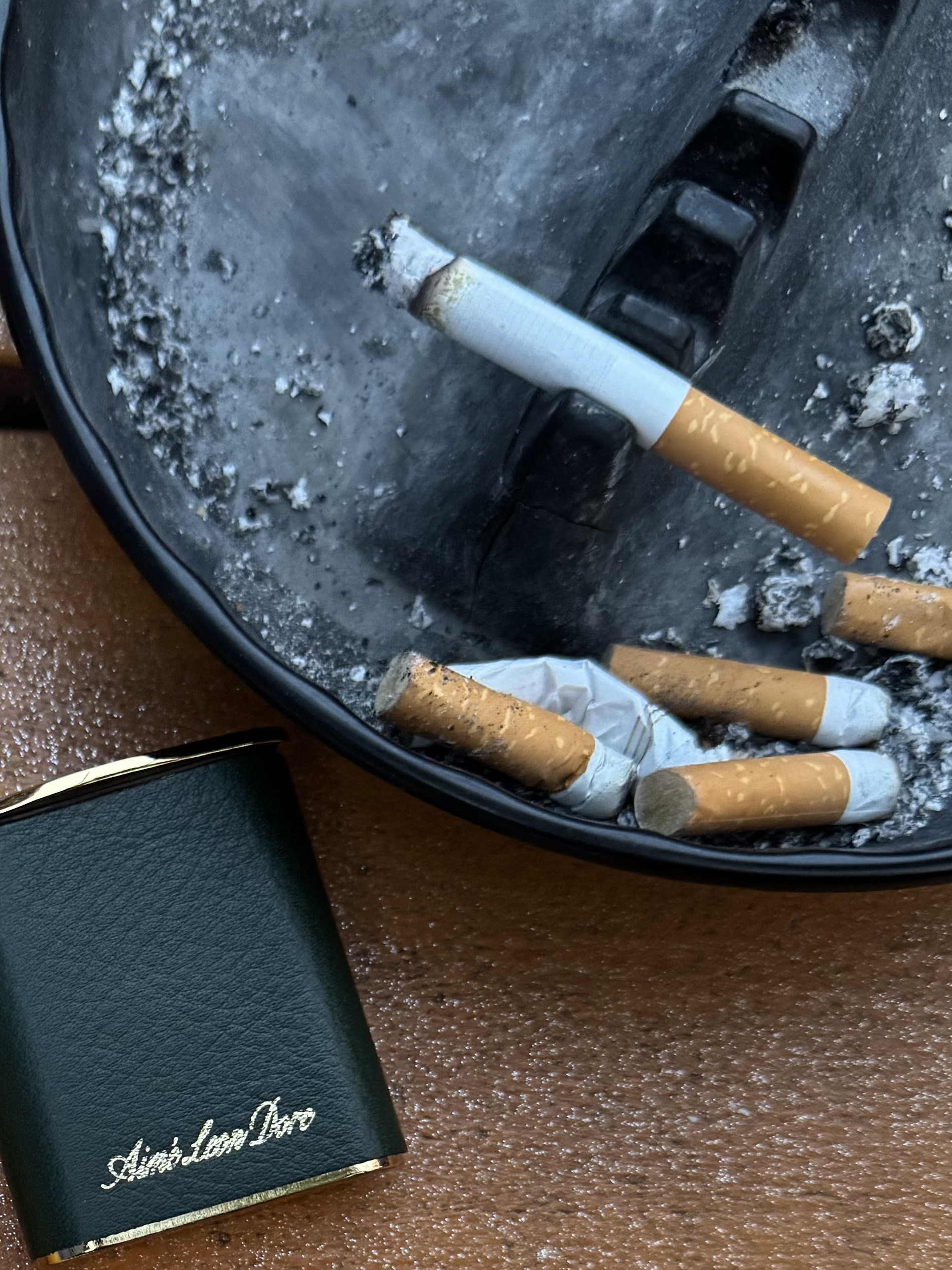
I spend a rather pathetic amount on cigarettes in a month,
and whilst I do not feel obliged to calculate the exact total, I am aware that I should feel little pride about my habit. After all, there is something shameful about asking a friend, who is a flight attendant, if he can pick me up duty-free cigarettes – he cannot, as he buys them for his father to resell at a markup. It does, however, feel less shameful to be given a carton of two hundred cigarettes as a souvenir from a friend who has made pilgrimage to the mainland or when a relative visits from the States. In those moments, I feel smug with the knowledge that I am rather easy to buy a gift for.
That smugness waivers in my weekly walks to the off-licence to pick up a pouch of tobacco, or when my fingers can bear to roll no more and I have to make my trip to a specific shop in the East End where I ask for a pack of straights. I could buy a pack anywhere, yet this particular shopkeeper allows me to feel dignified in the sales process. He always waits for me to tap on the counter to bring out the cheaper tax-free cigarettes rather than beg for them. Perhaps that is the greatest sales experience a young man can have; one that rivals the snooty, yet polite, service one receives in a store, such as Fortnum & Mason.
Whatever the calculation, I am aware that I smoke too often, though that does not mean I see an end to my habit in the near future.
Giving up is an option for the future.
I once spoke to a man – whose PhD made me trust him more than most – who told me that should I give up by the age of thirty, I could minimise all health risks commonly associated with smoking. I did not press for journal articles or scientific papers which could support his statement, for it is easier to believe what you wish to hear. I cannot ask him now either, as we have not spoken in months – perhaps for the best. Often, I consider how difficult I will find it if I do give up at thirty; the fear of such a task makes me believe forty is a better age to retire the sticks and turn to cycling or running.
There is comfort in knowing that at the point I give up, I won’t be alone: no matter how many articles and statistics are released about how youths no longer smoke, I seem to find myself surrounded by the 11.9% of UK smokers. Writers tend to write less on cigarettes compared to the past; it is either a less attractive to write about or they must assume that we all smoke less than we do. I assume it is the latter. Smoking, after all, is a thing of the past – of a bygone era where doctors prescribed cigarettes and women purchased holders to protect couture gowns. That is, nonetheless, a lie (the part where smoking has become a historical tale).
“In those moments, I feel the tired emotion of a somewhat dirty addiction.”
The youth of today still smoke. There are specific crowds where smoking feels like an entry-level role. Those who attend party-centric universities, such as Bristol and Leeds, maintain the charm found in a rollie. The London crowds made up ‘creatives’ (who either have obscure jobs or are simply unemployed with a middle-class background) also roll – though some do smoke straights, bought with money I am unaware as to how they are capable of having. It goes without saying that the crowd from those universities, do often become part of the London crowd after graduating. To those crowds, smoking remains cool. Not in a leather jacket (though those remain fashionable) and Converse (exchange those for Rick Owens) way, but in an anti-vape revolutionary form. This modern youth find itself returning to the roots of nicotine abuse.
At times, I sit in the garden of The Shacklewell Arms or outside the The Ten Bells, cigarette dangling on my lips watching those around me light their first cigarette of the evening. There are moments of jealousy, where I watch someone roll perfectly or overhear the sigh signifying this is their first cigarette of the day: a shot of envy that they could maintain enough composure to avoid their office smoking area all day. In those moments, I feel the tired emotion of a somewhat dirty addiction. My days are spent rocking myself warm in the rain, running from my desk between meetings to give myself some energy, and hiding under the scaffolding of construction feet away from my office. There is shame in being a smoker when not in a graphic tee and wide-leg jeans; my uniform of a thin jumper and slim-fit trousers are covered in accidental ash and a smell that mingles with the light office-friendly perfume I sprayed before leaving for work. At times, when the thick tar on my lungs seeps out of my pores, I become a creature spraying perfume constantly, all whilst acknowledging that no overpriced perfume can mask the smell of what has become ash. What I have attempted to say is that I that I partake in a version of smoking which is neither cool nor a social habit. Rather, I partake in the form where those like me are made to stand segregated on the street as cafes no longer want to house smokers on outdoor tables.
There is something ‘common’ about it all.
The air of ‘cool’ cannot be maintained throughout the day, every day. It is the curse of a normal addiction – it lacks the dramatic flair of a cocaine addiction or the shock value of a sex addiction. Nonetheless, it is still an addiction: a necessity.
There is nothing spectacular about a glass of water; a glass refilled multiple times during the day, though there is an element of elegance to a glass of wine to close an evening. For non-alcoholics, it is the polite statement that they are relaxing; I shall liken it to the Dalston man who smokes outside A Bar with Shapes for a Name. He blows the smoke into the faces of friends or potential lovers. He makes a statement: he is relaxed and thus, he is cool. He smokes to accessorise his day, rather than use a cigarette as an essential item. He does not run to the smoking area at work every hour to calm down after a meeting or reward himself for completing a task. When the Dalston man want to go back inside the bar, he kills the butt instantly, even when there is more yet to burn. He does not need to smoke to relax, he uses it to highlight he is already relaxed.
I feel no pride because the cigarette has become more than an accessory to me. I disgust myself a little, but I excuse my actions by acknowledging my youth. I shall give up one day – although I am yet to decide when that is. All I know is that on my deathbed, I will know that these cigarettes I have smoke now are what have made life a little easier. Perhaps I shall regret how I exchanged days, if not months, of my life for tobacco but I do not have time to think of my future regrets at this very moment. After all, as I finish writing this, I can feel the tingling sensation telling me it’s time to have a smoke.